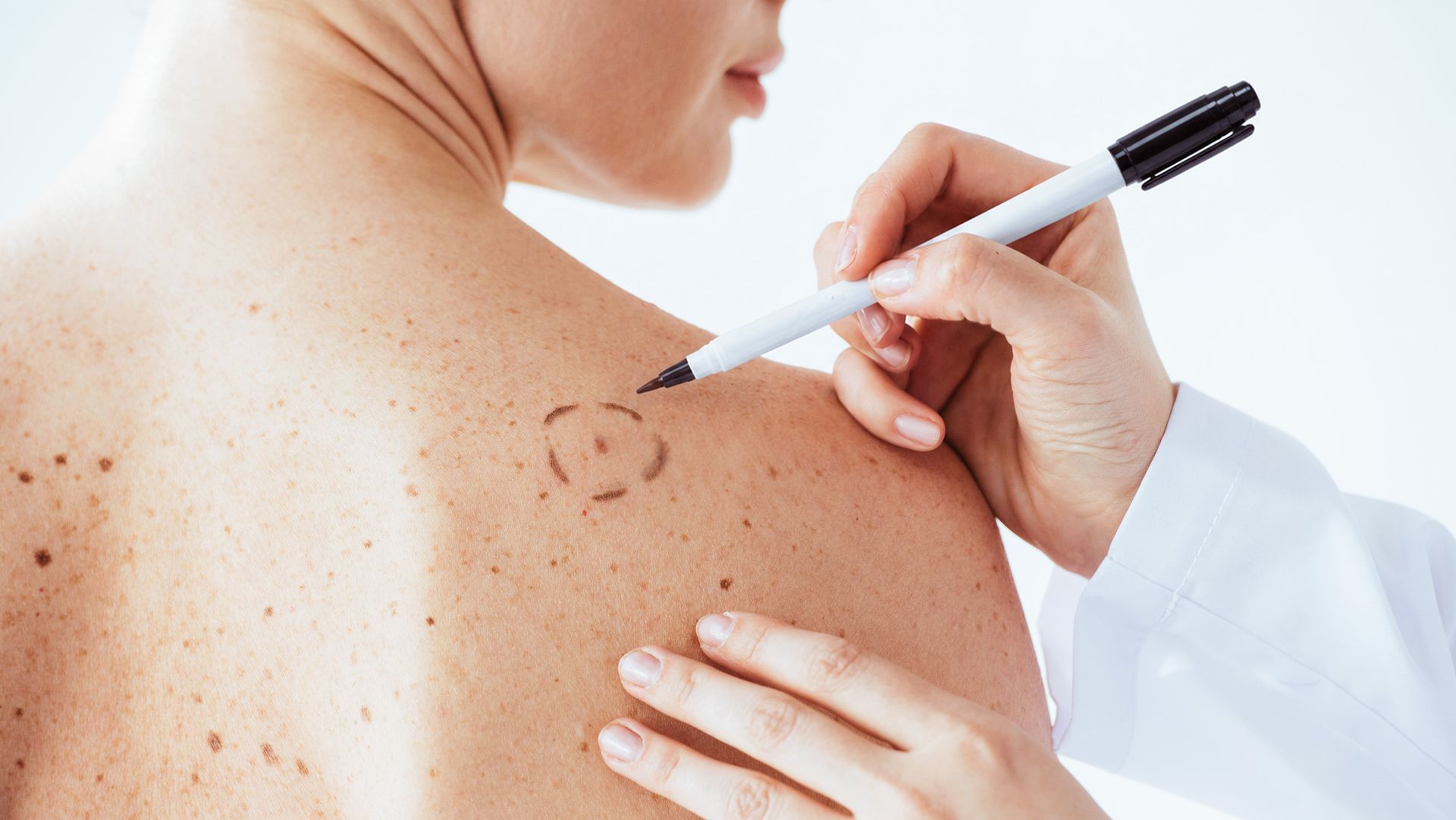
Quick Answer: If you can’t remember when you last checked your moles, now is the time. Check your moles at home using the ABCDE rule, and book a Consultant-led check for any mole that has changed, looks different from the rest, or simply worries you. At Montrose London in Belgravia, an individual mole check starts from £190, and is performed and reviewed by a GMC-registered Consultant Dermatologist, with a written report emailed the same day.
When did you last check your moles? It is an easy question to put off when nothing hurts and life is busy. A mole check gives a mark you have been wondering about the attention it deserves: a closer examination, a clear explanation of what the clinician sees and a practical next step. You do not need to recognise skin cancer yourself before asking for help.
Why Autumn Is a Good Time to Check Your Moles
The Met Office has confirmed summer 2026 as provisionally the hottest on record for the UK. It was also the sixth sunniest, with 621.9 hours of sunshine. Ultraviolet radiation damages skin cells, and Cancer Research UK says up to 9 in 10 cases of melanoma in the UK could be prevented by staying safe in the sun and avoiding sunbeds.
There is no clinical reason a mole needs checking this month rather than any other month. What autumn gives you is a prompt: a bright summer behind you, and a natural moment to look properly at your skin. If it has been a while, this is that moment. How often a professional should look is a separate question, and we answer it in our article on how often to have a professional mole check.
What Can a Mole Check Tell You?
A professional mole check assesses the features of a particular mole or skin lesion and whether it needs reassurance, monitoring or further investigation. Dermoscopy adds a magnified view of patterns that ordinary eyesight cannot show. That matters when a mark is difficult to judge, has subtly changed or looks unlike the rest of your skin. At Montrose, the assessment is Consultant-led and the findings are explained before you leave.
The benefit is a clearer understanding of your own skin. A stable-looking mole, a new mark and a changing lesion may need different next steps. If tissue testing is needed, a biopsy provides information that a visual examination alone cannot confirm.
How to Check Your Moles at Home
Most people have between 10 and 40 moles, and most are harmless. A home check takes a few minutes. Use a full-length mirror in good light, with a hand mirror or someone you trust for your back and scalp. Then apply the ABCDE rule that dermatologists use:
- Asymmetry – draw a line through the middle of the mole. The two halves of a harmless mole usually match
- Border – smooth, even edges are reassuring. Ragged, irregular or blurred edges are not
- Colour – a single shade of brown is typical. Several colours, or uneven colour, deserve a closer look
- Diameter – a mole larger than a pencil eraser, about 6mm, should be examined, especially alongside other warning signs
- Evolving – any change in size, shape, colour or a new itch, bleed or crust, is a reason to be seen
A mole does not have to show every ABCDE feature to deserve a closer look. Melanoma can also be smaller than 6mm, so do not wait for a changing mark to reach that size. Use the checklist to notice differences, rather than as a test a mole must pass before you book a mole check.
Also look out for a new mole, and for any mole that looks noticeably different from the rest. A home check is a starting point, not a verdict: only a medical professional can accurately assess a mole for features of skin cancer.
Which Mole Check Is Right for You?
Montrose offers three routes, and all services are performed and reviewed by a GMC-registered Consultant Dermatologist.
- Individual mole check – for one or two moles you are concerned about, which your Consultant Dermatologist examines using digital dermoscopy. A single lesion check is £190 and takes 10 minutes. Two lesions are £275 and take 15 minutes
- Full body mole mapping – creates a permanent digital record of every visible mole using the Canfield Scientific IntelliStudio3® with DermaGraphix®, so that future appointments can be compared against that baseline. It takes 45 to 60 minutes and starts from £495
- Dermatology consultation – a full review of your skin with a Consultant Dermatologist, suited to a broader concern than a single mole. It takes 30 minutes and costs £350
Choose the Scope That Matches Your Concern
An individual mole check focuses on one or two marks you want examined. Full body mole mapping adds a photographic baseline for comparison over time, which is particularly useful when there are many moles to keep track of. A broader dermatology consultation gives space to discuss other skin concerns alongside your moles. Each route offers a different scope of care, so the most useful choice depends on what you want help with.
Mole Check Fees at a Glance
| Appointment | Fee |
| Individual mole check – one lesion | £190 |
| Individual mole check – two lesions | £275 |
| Full body mole mapping | From £495 |
| Dermatology consultation | £350 |
These are assessment fees. If for example, your mole check leads to a recommendation for removal or laboratory analysis, please ask our team for the separate costs so you can understand the full plan before proceeding.
Book sooner rather than later if:
- a first-degree relative has had melanoma or non-melanoma skin cancer
- you have more than 50 moles, or several atypical or changing ones
- you have fair or freckled skin and a history of significant sun exposure or sunburn
- you have had skin cancer yourself
- a mole has grown, changed shape or colour, become symptomatic, or looks different from your others
You may simply want peace of mind, which is a perfectly good reason too.
Having fewer moles or darker skin does not mean a new or changing mark should be ignored. Include the palms, soles and nails when looking at your skin, and seek advice about a persistent unusual mark. Your personal history and the way a lesion behaves are more useful than relying on a single risk factor.
What Happens if a Mole Looks Suspicious?
Most checks end in reassurance. If a lesion does look suspicious, your Consultant Dermatologist will talk through the options with you on the day. Removal can be arranged within days and is performed by a Consultant Plastic Surgeon, with the tissue sent to an accredited UK laboratory for histopathology. The method depends on the mole’s size, depth and type. Excision provides a tissue sample for analysis, whereas laser removal suits smaller, non-cancerous moles- the choice is made with you after assessment.
An assessment result and a laboratory result answer different questions. Your mole check gives you the clinician’s findings on the day. If a mole is removed for histopathology, a pathologist examines the tissue under a microscope to establish the diagnosis; that report follows separately. This is why the same-day assessment report should not be confused with a same-day biopsy result.
For a lesion that may be melanoma, the priority is obtaining tissue for diagnosis. Laser treatment is not the diagnostic route for a suspicious mole because it does not provide the intact specimen needed for that examination. The team can explain the proposed procedure, expected scar and wound care, as well as the risks of bleeding, infection and healing problems.
If melanoma is confirmed, the core treatment is wide local excision, which removes the melanoma with a margin of healthy tissue. Sentinel lymph node biopsy may be discussed according to the melanoma’s thickness and other features, to check for spread to nearby lymph nodes. Confirmed diagnoses are discussed by Montrose’s own Multi-Disciplinary Team and you are supported by a dedicated Skin Cancer Nurse Specialist throughout treatment and further follow up. Skin cancer is one of the most treatable cancers when it is caught early, highlighting the importance of being proactive.
What to Expect at Your Appointment
- Book online – no referral is required, and you choose the check that suits you.
- A full history – your Consultant Dermatologist takes your personal and family history, discusses your concerns and assesses your individual risk.
- The check itself – your Consultant Dermatologist carries out dermoscopy of the moles of concern, or total body photography plus dermoscopy for mole mapping. It is non-invasive, with no needles or ionising radiation; the examination is usually painless.
- Same-day results – your Consultant reviews the findings with you in the room, and a written report is emailed to you the same day.
- Next steps – if a lesion needs removing, it can be arranged within days, with no additional referral.
Come without make-up, fake tan or nail polish, and skip heavy moisturiser on the day, as these can obscure lesions and affect image quality.
Bring a short note of which mark concerns you, when you first noticed it and how it has changed. Mention previous skin cancer, earlier mole removal and any close family history. If you have older photographs or pathology reports, these can give your Consultant useful context and help make your mole check more personal and focused.
Whether you want one mole checked or a baseline for your whole skin, book a mole check at Montrose London, or call 020 7112 8298 to talk it through first.
Montrose London is a CQC-registered, Consultant-led clinic at 19 West Eaton Place, Belgravia, London SW1X 8LT, offering individual mole checks from £190 and full body mole mapping from £495, each performed and reviewed by a GMC-registered Consultant Dermatologist, with same-day written results. Any removal is performed by a Consultant Plastic Surgeon. No GP referral required. Accepted by Bupa, Bupa Global, Vitality, Healix, Cigna, and WPA. Explore our Consultant-led skin services. Book at montroselondon.com, call 020 7112 8298 or WhatsApp 07354 848584.
FAQs
When Should I Get a Mole Checked?
Book a check whenever a mole changes in size, shape, colour, becomes symptomatic, or looks different from your other moles. Do not wait for an annual date if something has changed.
How Do I Check My Moles At Home?
Use a full-length mirror in good light and go through your skin methodically, asking someone you trust to look at your back and scalp. Apply the ABCDE rule: asymmetry, border, colour, diameter and evolving. Any change is worth having assessed.
Are Moles Dangerous?
Most moles are common, harmless skin growths, and most people have between 10 and 40. A small number can have a sign of skin cancer, which is why changes should always be assessed by a professional.
What Is The Difference Between a Mole Check And Mole Mapping?
An individual mole check is a Consultant-led assessment of a specific mole or two, using digital dermoscopy. Mole mapping combines total body photography with dermoscopy to create a permanent baseline of every visible mole, so that new or changing moles can be spotted over time.
Do I Need a GP Referral To Have My Moles Checked?
No. You can book directly with Montrose, with no referral required.
How Quickly Will I Get My Results?
Your Consultant Dermatologist reviews the findings with you in the room, and a written report is emailed to you after your appointment, on the same day.
If tissue is sent for laboratory testing, those results come separately after analysis. The team will explain when to expect the pathology report and how you will receive it.
Does a Mole Check Hurt?
No. Both individual mole checks and mole mapping are non-invasive, with no needles, radiation or discomfort.
Can a Mole Come Back After It Has Been Removed?
There is a small chance of recurrence if some mole cells remain in the skin, although the risk is lower with proper excision. Follow-up depends on the original diagnosis and your individual risk. If pigment or a lump returns in or around a removal scar, arrange a medical review.
Is a Mole Check Covered By Private Medical Insurance?
Individual mole checks may be covered depending on your policy and clinical indication. Mole mapping is generally not covered by insurance, although limited exceptions do apply. Montrose is on the approved panel for Bupa, Bupa Global, Vitality, Healix, Cigna and WPA, and will provide the documentation your insurer needs.
Can I Need a Mole Check Even if the Mole Does Not Hurt?
Yes. A change in appearance deserves attention even without pain, itching or bleeding. Look for a new or different mark and changes in size, shape or colour. The absence of discomfort does not tell you whether a lesion is harmless.3,6
Can a Small Mole Need Checking?
A changing mole can need assessment even when it is smaller than 6mm. Diameter is one warning sign, and evolution or a mark that stands out from your others can be just as important.6
Does a Mole Check Include Removal?
The appointment is an assessment. If removal is recommended, the clinician will explain why, how it would be done and whether the tissue needs laboratory analysis. At Montrose, removal can be arranged within days when needed; ask the team about the procedure fee and laboratory costs.2,9
What Should I Do After a Reassuring Mole Check?
Keep getting to know your skin and follow the review interval recommended for your circumstances. If you notice a new or changing mark before that appointment, seek advice sooner. A photographic baseline can make comparison easier, especially when you have many moles.3,5
Your GP can assess a concerning mole and refer you to a specialist if needed. You can also book a private assessment directly with Montrose. Choose a route you can access promptly when a mole has changed; you do not need to wait for a routine annual review